QUARTARARO SAYS HE AND YAMAHA HAVE CALMED THINGS DOWN AFTER ARAGON
11h ago·
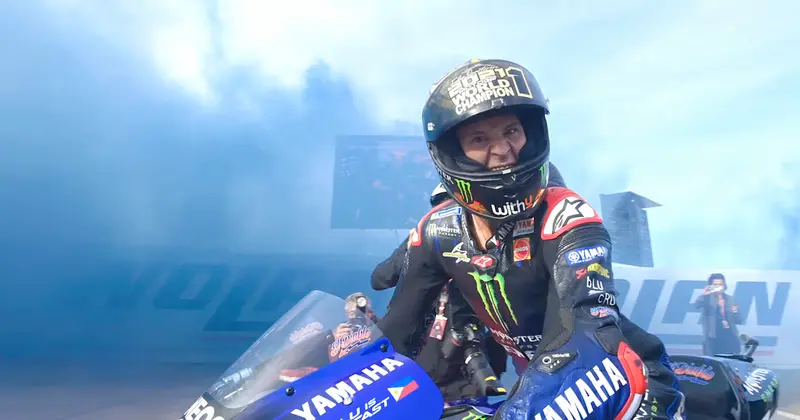
Fabio Quartararo says the results have not matched the promise of his early Yamaha years, but he insists his motivation is still there—provided he can get back to riding “to the limits” with a bike that finally feels right. Speaking in Yamaha’s hospitality at Misano, the Frenchman described a long, difficult stretch in which he has struggled to reproduce the form that once made him a benchmark rider for the M1.
Quartararo’s comments come against a backdrop of mounting pressure on Yamaha’s project. After a breakthrough period that culminated in his first MotoGP world title, the following seasons brought disappointment and a widening gap to the front. Speedweek notes that after the San Marino round—described as the 14th of 22 events in the 2026 calendar—Quartararo has managed only one podium in 61 Grand Prix. He acknowledged that “the results are not like five years ago,” adding with a half-smile that his potential is better than ever. He also said he has been in a “difficult phase for a long time,” and wants to return to what he does best: pushing the motorcycle to its limits, but only if he feels comfortable on it.
The relationship between Quartararo and Yamaha has also been strained by the pace of development. Early in 2026, he said Yamaha was “not able to be fast,” and in later remarks he pointed to a lack of progress while also admitting his impatience. Speedweek reports that rumors about a move to Honda for 2027 and 2028 were already circulating before he had even ridden the V4-powered M1. Quartararo also referenced a private meeting with Yamaha after the Aragon Grand Prix, saying it was held to prevent further public tension during the final three months of his contract. In Misano, he admitted that “we said things out of frustration that maybe weren’t completely right,” and added: “We met last week and we sorted everything out.” Speedweek adds that the aim now is to focus on the sport in their remaining shared Grands Prix and to end the collaboration as positively as possible.
On track, Quartararo’s weekend in Misano produced a 10th place in the Sunday race, and he also reached Q2 in Friday qualifying at Spielberg by finishing 10th. He said the key was extracting the best from the Yamaha under braking: “We must ride like this to get into a good position—especially on the brakes.” He explained that he found his quickest laps on the brakes because the Red Bull Ring has many hard braking zones, and that on his last run he missed the braking point in the first corner, then again in later corners, leaving him without a “clean” lap—though it was still enough to secure Q2. Quartararo also said he always gives “100 percent,” noting that sometimes it brings a top result and other times a lower place, depending on how he feels. He pointed to what he lacks—grip, turn-in and speed, and even aerodynamics—while insisting he still gives his maximum.
Yamaha team director Massimo Meregalli offered context on how Quartararo’s talent both masked and exposed the bike’s problems over time. He recalled Quartararo’s early arrival to MotoGP, emphasizing the speed he showed even when riding for Petronas. Meregalli said Quartararo’s first-year Jerez pole was “incredible,” and that when other Yamaha riders checked the data, they could see the cornering speed but “couldn’t replicate it.” He argued that Yamaha’s earlier success was partly built on Quartararo covering up limitations: “The problems we had from year to year were covered by him and by what he could do.”
Meregalli also pointed to a broader structural issue within the team. He said that while other riders like Valentino Rossi, Maverick Viñales and Andrea Dovizioso also faced problems, Quartararo remained fast—until the limits that had existed from the start became increasingly difficult to overcome. He suggested Yamaha’s struggle was not only technical but also tied to the consequences of losing time in development: “If you lose one or two years in racing without success, in reality it’s more.” He added that Yamaha had structural issues that Rossi had already highlighted years earlier, yet they were somehow kept rather than fully addressed. In his view, the intense manufacturer competition has changed everything: Ducati raised performance and technology to a high level, and other European brands responded quickly, while Yamaha’s approach differed—though he said the team has since strengthened its workforce and is building knowledge.
Behind the scenes, Yamaha is trying to change how it works. Speedweek reports that Yamaha is aiming to “go full throttle” in 2026 to overcome stagnation, and Meregalli said there is now a “different way of working.” He described improved collaboration between Europe and Japan, noting that in the past development was handled in Japan and logistics were managed in Italy, but that is no longer the case. He said the Lesmo workshop is expanding and that Yamaha is developing more areas, including aerodynamics and electronics, with greater synergy between YMR in Lesmo and YMC in Iwata.
Quartararo’s own recent history reflects both flashes of speed and frustration with setbacks. Speedweek recalls that in 2025 he scored five pole positions and came close to winning at the British Grand Prix, only for a rear ride-height device system to fail. He said that in 2023 and 2024 results were missing, but in 2025 he felt qualifying potential and used those chances: “I was quick. For myself I could say: ‘I know what I need… and I can do it.’ That gave me the feeling of not losing. I knew my abilities.”
However, the transition toward the V4 era has not delivered the step forward he expected. Quartararo said that when Yamaha tested the new bike in Barcelona, the feeling was not particularly good, and that it was “really, really similar” to what he experienced in September during the raw V4 test—despite expectations of a bigger improvement. He also said Yamaha started 2026 already slower than the previous year.
In Misano, he admitted that the situation is not enjoyable because he cannot push to his limits the way he could in last year’s qualifying. Still, he said there are moments—such as Le Mans—when things go better than expected and you can “use the moment and enjoy it.”
Looking ahead, Quartararo described his mindset for the Honda chapter as a readiness phase rather than a hope-and-wait approach. “When the new chapter begins, I have to approach it as if I were going to war,” he said, comparing himself to a dog that has gone without food for days and will bite when fed—meaning he wants to be fully prepared when everything comes together. Speedweek also reports that Yamaha will move to a new era in the factory team with Jorge Martín and Ai Ogura, while Quartararo hopes Honda’s R&D can be faster and more effective than Yamaha’s.
For Yamaha and Quartararo, the immediate future is therefore defined by two parallel goals: Yamaha’s push to accelerate its development and Quartararo’s determination to arrive at his next contract phase ready to extract performance from a machine that finally matches his riding style.