YAMAHA SAYS ITS 2028 MOTO3 BIKE IS A PROTOTYPE, NOT A PARTS BIN DERIVATIVE
4 Aug·
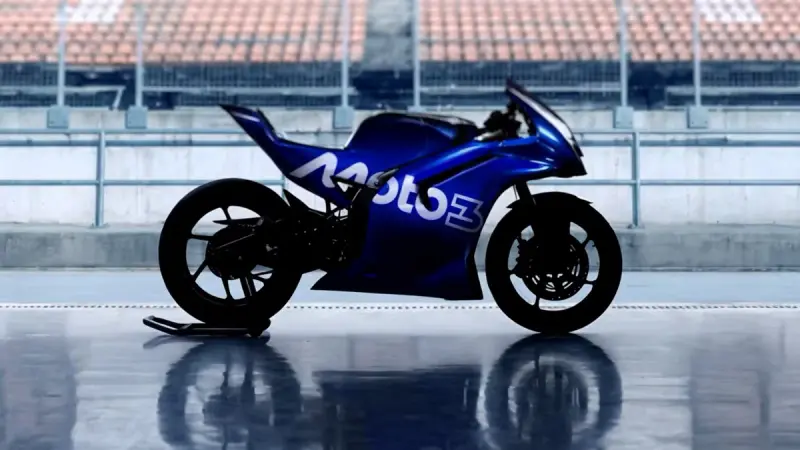
Yamaha has outlined its plans for a new Moto3 machine that it will supply exclusively from 2028, insisting the project is built as a true racing prototype rather than a simple offshoot of existing production hardware.
MotoGP’s chief sporting officer Carlos Ezpeleta said the performance target is to move beyond today’s Moto3 package, aiming for “around 120 kg with over 95 horsepower.” He also framed the technical and sporting direction as a way to address issues within the current Moto3 structure. Ezpeleta’s key goals include ensuring “all riders will be able to compete with exactly the same machinery,” making the bike “more suited for today’s riders in terms of the age and [bigger] size,” and cutting costs so that Moto3 reaches “50% of the current cost for Moto3.”
Yamaha Racing managing director Paolo Pavesio reinforced that cost reduction will not come at the expense of the bike’s purpose-built nature. “This is not a production bike spin-off,” he said. While the engine is described as a production unit, Yamaha plans to “highly modify” it, with major changes aimed at weight and output. Pavesio said the company is “massively reducing the weight by using a lot of magnesium,” and that the project will feature “a complete racing gearbox.”
Crucially, Yamaha stressed that only the engine originates from production. “The engine is the only production part of the bike,” Pavesio said, adding that the frame, swingarm and rolling chassis are designed as a “prototype racing machine.” He also rejected the idea that the new Moto3 could be assembled by borrowing components from Yamaha’s existing platforms: “We didn’t take one bolt from existing Yamaha parts, from the Superbike platform, to build the new Moto3.”
Development is already underway, with Yamaha describing a broad internal effort. Pavesio said the company has assembled a “cross-company group of young engineers” to design the machine, including staff from Superbike and MotoGP operations, plus university students. He noted that while the team includes people from Japan, many are based in Italy because “the bike has been developed mainly in Europe.” Yamaha also said the testing programme is scheduled to begin in September or October.
Beyond the technical brief, Yamaha’s motivation for entering Moto3 was presented as strategic rather than purely commercial. Pavesio said the programme is “not really to generate business, but it’s to generate knowledge,” and to “connect with younger audiences” in regions where motorsport and motorcycle demand are growing. He specifically referenced “South America, Asia,” arguing that Yamaha’s global presence and MotoGP promotion can help build interest in those markets.
Even with Yamaha as the exclusive supplier, Pavesio said the company wants other manufacturers to remain involved in the class, drawing a parallel with the Moto2 model where Triumph powers the bikes. He said Yamaha “doesn’t care about having any Yamaha branding on the bikes” that Moto3 teams purchase, and that it “doesn’t want to use the fact that we supply the machines as a direct branding promotion.” Yamaha also confirmed it will run its own team, stating: “We will have our own team. This is very clear.”
In the same way Yamaha competes in Moto2 through the Yamaha Pramac project—using a Boscoscuro chassis with a Triumph engine—Pavesio suggested the Moto3 approach will focus on development and participation rather than turning supply into a branding exercise.
Overall, Yamaha’s message for 2028 is clear: the new Moto3 package is intended to be lighter, more powerful, and cheaper, while standardising machinery for riders and positioning the class as a platform for long-term knowledge and audience growth.