FERGUS CAMERON, LONGTIME PHILLIP ISLAND GRAND PRIX FIGURE, DIES AT 78
9 Sept·
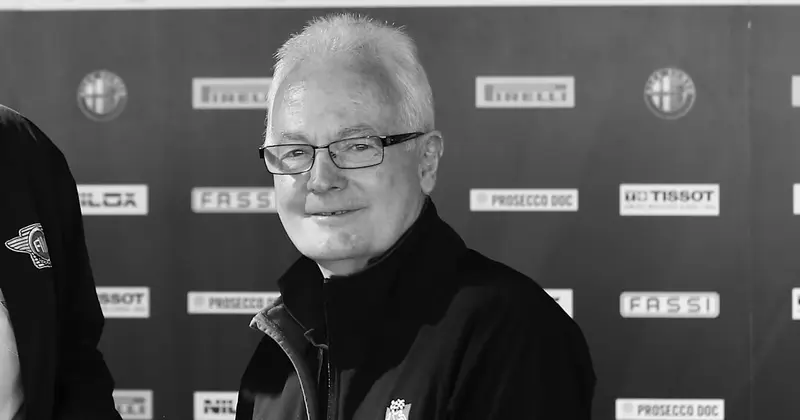
Fergus Cameron, the longtime driving force behind Phillip Island’s Grand Prix circuit, has died in Australia at the age of 78. According to Speedweek, he passed away on 9 September 2026 after several years of health problems and had withdrawn from public life.
Cameron served as Managing Director of the Phillip Island venue until 2022, and he was last present at a Grand Prix in that same year. Throughout his time at the track, his wife Chris was described as a constant support—handling administration and logistics and playing a key role in the event’s smooth running. Cameron previously recalled that the couple lived only about ten minutes from the circuit, and that they regularly hosted an evening at home during Grand Prix and Superbike World Championship weekends. In an interview with Speedweek in 2022, he said: “Bisher hatten wir bei allen Grand Prix und Superbike-WM-Rennen immer einen Abend bei uns im Haus.” He added that they invited team managers and Dorna CEO Carmelo Ezpeleta, along with figures such as Mike Webb and Franco Uncini, and that the nights often included a “Sing-Wettbewerb” between Australians, Spaniards and Italians.
Cameron’s knowledge of Phillip Island was extensive, and Speedweek’s retrospective highlights how deeply the circuit’s history is tied to his life’s work. The venue traces its roots to early racing on an unpaved road course dating back to 31 March 1928, when the track measured 10.4 km. It was later expanded in 1935 to 19.3 km, before being shut down after 1941 due to heavy dust. A permanent circuit design began in the early 1950s, and Phillip Island officially opened in March 1956. Motorcycle club meetings followed later that year, while the circuit was primarily used for car racing—most notably the “Armstrong 500.”
Motorcycle racing returned each New Year’s Day with the Victoria Grand Prix, and Speedweek notes that Tom Phillis won twelve races there between 1959 and 1961 on Honda and Norton, earning the title “King of Phillip Island.” A change of ownership came in 1962 when Len Lukey purchased the circuit and, together with PIARC, launched a rebuilding program. Racing resumed in 1967, but after Lukey died in 1978 the circuit fell into disrepair again, with only sporadic race meetings. Even today, Speedweek says the Lukey Heights corner remains a reminder of him.
The first Phillip Island Grand Prix that Cameron is remembered for hosting dates to 1989. Speedweek reports that 90,000 spectators arrived via the narrow access roads, and that the return to Melbourne—normally a two-hour drive—took until Monday at 5 a.m. due to traffic.
The venue also became a regular stop for other top-level motorcycle racing. In 1990, the Superbike World Championship—founded in 1988—made its debut at Phillip Island, and Speedweek states that SBK has appeared there every year since, with the exceptions of 1993 and 2021.
Cameron’s role in securing the circuit’s future began with a difficult ownership situation. Speedweek describes how, at first, local politicians were not interested in getting involved, leaving the owners to handle matters themselves. The original group was made up of local farmers who, in the 1980s, had raised the required 700,000 dollars with difficulty. Cameron, who came from a farm background, was given only 60 days to gather the money needed to complete the purchase. He later recalled the condition of the circuit, saying: “Die Rennstrecke war eine Ruine. Die Gebäude waren heruntergekommen, die Fenster zerbrochen, überall weideten Schafe.”
Speedweek says Cameron drove the fundraising effort within the tight deadline and took over the Phillip Island Grand Prix Circuit in 1985 through a newly formed consortium called Placetac Pty Ltd. It also reports that Cameron had heard in time that the FIM would award an Australian Grand Prix in 1989. Engineer and race promoter Bob Barnard and his Barfield Company selected Phillip Island for the event. To prepare, the circuit was shortened by 0.5 km to 4.445 km and upgraded with an investment of A$5 million.
Cameron’s tenure also intersected with later investment. Speedweek notes that in 2004, businessman and former footballer Lindsay Fox—through Linfox Property Group Pty Ltd—became an investor and acquired the circuit for a reported A$13 million, with his son Andrew Fox later taking over responsibility for the venue.
Across decades of change—from the circuit’s early road-racing origins to the modern Grand Prix era—Cameron’s legacy is presented as both operational and personal: a figure who knew Phillip Island intimately, built the event’s infrastructure under pressure, and helped shape the atmosphere around the race weekend, including the hospitality he described in his final Speedweek interview.