GUINTOLI FLAGS YAMAHA’S 2027 FUEL CONCERNS AND QUESTIONS HONDA’S 850CC TEST PACE
25 Sept 2026·
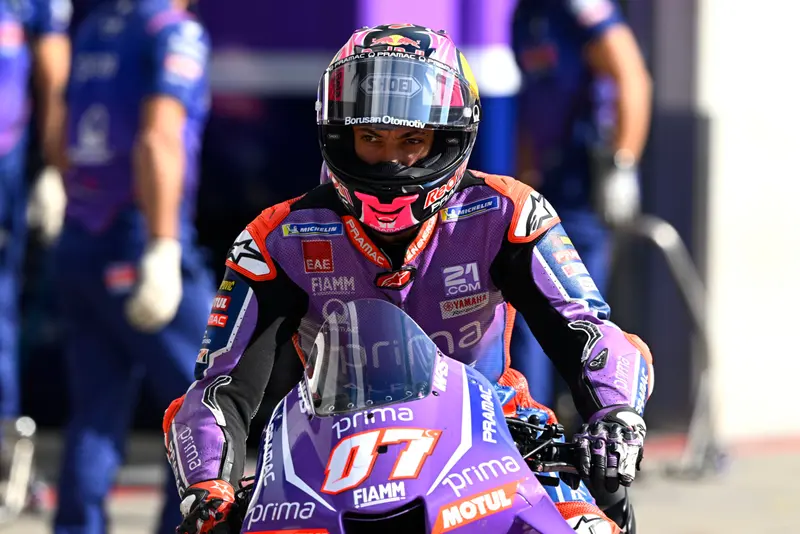
Sylvain Guintoli believes Yamaha could face a significant fuel-efficiency challenge when MotoGP switches to 850cc engines and fully renewable fuel in 2027, adding to questions raised by the team’s pace at a recent test.
The field remained at Austria’s Red Bull Ring for an official 850cc test after the 2026 Grand Prix. Honda’s Diogo Moreira set the benchmark with a reported 1:28.4, five tenths quicker than Pedro Acosta in second and only half a second off Jorge Martin’s pole time from Saturday. Track conditions differed, and some riders used 1,000cc bikes, making comparisons difficult. Leaked times reportedly put Toprak Razgatlioglu 15th, with a lap of 1:30.0. The Pramac rider was among Yamaha’s testers, alongside teammate Jack Miller and test rider Augusto Fernandez. Izan Guevara, who is due to replace Miller at Pramac in 2027, also rode, but on a detuned version of the current 1,000cc M1.
Guintoli said Honda’s 850cc looked promising, but questioned the size of Moreira’s advantage. “I found it a bit weird that Moreira would go half a second faster than P2. That’s a big difference,” he said on the Gas It Out podcast, noting that some riders had been on 1,000cc machinery. Johann Zarco was also near the front, which Guintoli called “a good sign for next year” and for Fabio Quartararo. Honda engineers reportedly believe Quartararo, who is joining the manufacturer, could be a genuine threat in 2027. However, Ducati and Aprilia were said to be using less-developed 850cc packages, while Honda’s bike appeared more radically different. That may mean the leading manufacturers are holding back some developments to make them harder to copy.
The 2027 rules will reduce engine capacity from 1,000cc to 850cc, prohibit ride-height devices and impose further aerodynamic restrictions. They will also require fuel made entirely from non-fossil sources. Guintoli warned that the new fuel could make efficiency especially important. “That type of fuel makes the bike more thirsty, it consumes more fuel,” he said, adding that fuel efficiency would play a “massive, massive role” in performance.
He sees a particular risk for Yamaha, which has already encountered fuel-consumption concerns with its new V4-powered 1,000cc bike. Guintoli said the manufacturers’ performance is close in horsepower and torque, but the bikes are using more fuel. He also cautioned that the smaller engines may not automatically solve Yamaha’s problem: “Unfortunately, I fear that with the 850s – they’re essentially like a smaller version of the 1,000s – and the lack of power that they have with the 1,000s, it feels like we’re going to find that proportionally, at the moment anyway, with the 850s.” He described the prospect as a possible “double whammy” for the manufacturer.
There is, however, a more encouraging assessment from Yamaha. Managing director Paolo Pavesio believes the 850cc bike has recovered the cornering character that has traditionally been a strength of the M1. Yamaha riders have complained that the move from an inline-four to a V4 in 2026 cost the bike some of that ability.
The renewable-fuel requirement is also raising concerns about costs across the paddock. MotoGP has confirmed that fuel from 2027 must be 100% renewable, produced as biofuel or e-fuel rather than through crude-oil refining. A report by GPOne says the change could push prices to €86 per litre, or about £74. Independent teams without fuel partners may be particularly exposed. Yamaha has its Yamalube subsidiary, while Ducati, Honda, Aprilia and KTM have partnerships with Shell, Castrol and Mobil 1. Liberty Media is reportedly considering covering fuel costs to help prevent smaller teams from bearing the full increase.