MOTEGI KART EVENT RAISES CONCERNS OVER RIDER PREPARATION
5 Oct 2026·
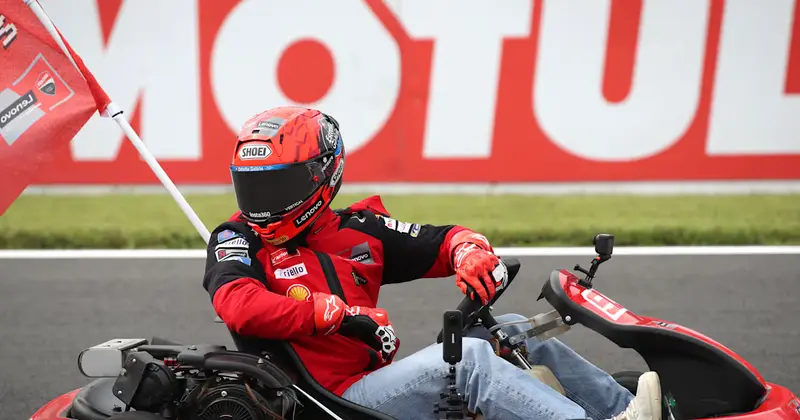
A kart race staged at Motegi on Sunday, between MotoGP warm-up and the Grand Prix, has prompted questions about how much extra activity riders should be expected to take on during a race weekend.
Honda stand-in Somkiat Chantra edged KTM’s Pedro Acosta to win the event. Helmet audio from some competitors added an entertaining element, with Pramac teammates Jack Miller and Toprak Razgatlioglu providing a lively exchange that let viewers hear the action directly. The format also hinted at how live rider communication might feature in future MotoGP broadcasts if the series’ radio system develops.
The event had clear promotional appeal: it put the riders in an unfamiliar setting, offered spontaneous moments for social media and gave fans a chance to see more of their personalities. Efforts to broaden MotoGP’s audience and make its stars more relatable are worthwhile, but the timing in Japan was questioned. The hours before a Grand Prix are used to review data, make final decisions, manage physical problems, eat, hydrate and focus on the race.
Marc Marquez did not take part himself, sending a lookalike in his place. After warm-up, he needed to ice his injured right shoulder and did not want to risk aggravating it before the race. He explained his priorities bluntly: “I’m here to fight for the world championship, not for fun or a few laps in a kart.” The source argues that arranging a stand-in was an awkward way to handle the situation, but that the reason behind his absence deserves attention.
Marquez was not alone in worrying about the risks. Jorge Martin, his title rival, also feared that a kart collision could affect the Grand Prix and stayed out of the contest. Although karting is not motorcycle racing, contact is possible, and competitive riders are unlikely to treat a race as a gentle parade. Chantra’s close finish with Acosta showed that the participants were competing seriously.
The concern extends beyond one event. Riders already face practice, qualifying, a sprint and the Grand Prix, alongside media duties, sponsor appearances and fan activities. With the paddock travelling directly from Motegi to Mandalika, recovery time is especially important for those carrying injuries. Extra promotional commitments, the article argues, need to be scheduled with care.
There was also an irony to the spectacle: the main MotoGP action in Japan offered little sustained fight at the front. Marquez won both the sprint and Grand Prix in controlled fashion, with no prolonged battle for victory. A kart race cannot make up for a lack of on-track drama, and helmet audio, while potentially adding intimacy to coverage, is no substitute for exciting racing.
The conclusion is not that MotoGP should abandon new fan-focused ideas. Rather, such activities should be planned with riders, placed in suitable time slots and allow competitors to opt out for health reasons. A rider who needs treatment before a Grand Prix should not have to justify prioritising it. The strongest promotion, the source argues, remains a compelling race in which riders can perform at their best.