MOTEGI’S REINFORCED REAR TYRE DRAWS RIDER SCEPTICISM
1 Oct 2026·
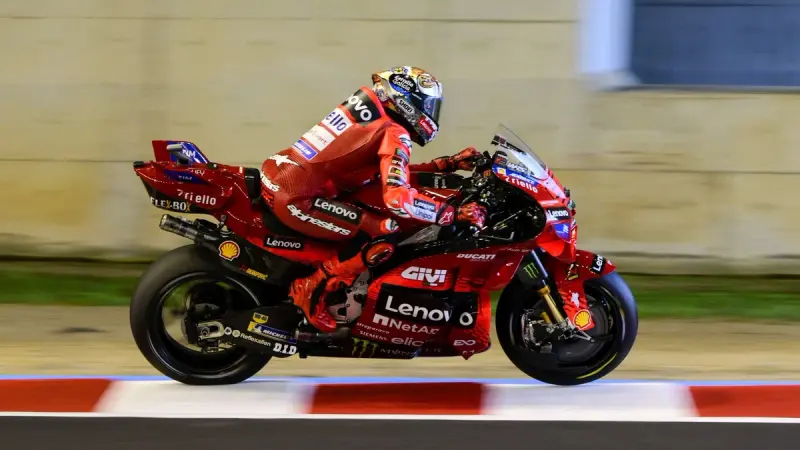
A newly resurfaced Motegi has prompted Michelin to revise its tyre choices for this weekend’s Japanese MotoGP, creating an early question for Ducati: how will its bikes cope if the hardest rear option proves quickest?
With no test data from the new asphalt, Michelin has prepared three front and three rear compounds, drawing on simulations and information from previous visits. The front Soft, Medium and Hard retain last year’s stiffness and all have symmetrical compounds. The Hard front uses a reinforced construction intended for some Asian circuits and also planned for Mandalika.
At the rear, Michelin has increased stiffness across the allocation to provide extra protection against uncertainty from the resurfacing. The Soft and Medium use the standard casing; the Hard has the reinforced casing that Michelin brought to Austria, where Ducati struggled to find grip. The construction is designed to limit heat build-up under repeated acceleration and has been used this year at Buriram, Mandalika, Spielberg and Goiania. At Motegi, however, it is available only with the added Hard rear, rather than across the range as at some of those venues.
Motegi’s previous tyre pattern offers a starting point, but not a guarantee. On the old surface last year, riders generally chose the Medium front for both races, pairing it with a Soft rear in the Sprint and a Medium rear in the grand prix. The resurfacing is expected to offer more grip, but several riders have already indicated they would prefer the standard-casing options if conditions allow.
Jack Miller was particularly blunt after his difficult Spielberg weekend. “It's not an option,” the Pramac Yamaha rider said of the Hard. “If we're using that tyre, I'd pack up and go home.” He added: “I mean, being sarcastic, but at the same time, I'm not. I'll see what we can do this weekend.”
Honda’s Luca Marini also expects to favour the softer choice, given the importance of grip to the RC213V. He was in the top 10 from the start at Misano, but finished 14th in Austria after missing Q2. “If we have a softer tyre, we use always a softer tyre, the one with more grip,” he said. “But, if there is a high degradation on the tyres, we keep it in consideration. But usually when we have the standard casing, we prefer always the standard casing.”
If the new track favours the reinforced Hard rear, Ducati could face a challenge after its difficulties with that construction at the Red Bull Ring. Marc Marquez said the grip problem was not unique to Ducati, but acknowledged the team needed to make progress. “In the end, it's the same for everybody,” he said. “It's true that we need to work well [on the stiffer rear tyre], because in Thailand we struggled a lot, here again we struggled a lot, but at least here we were competitive.”
At the Austrian round, Marquez took second in the Sprint after Pedro Acosta crashed while leading, then finished fifth in the grand prix as the top Ducati. He had also lost time early in the race with brake issues. Even without those problems, the Desmosedici appeared unable to match Acosta and Jorge Martin at a circuit that has traditionally suited Ducati.
Marquez was already looking ahead to the next round in Indonesia, where Michelin will bring another special casing. “So let's see if we can improve for Mandalika especially, where again we have not this one, but another special casing,” he said. He did not specifically refer to the reinforced option also being available at Motegi.
Cool conditions forecast for the Japanese weekend may reduce the chance that the Hard rear becomes the preferred choice, although rain is also possible. Michelin’s Piero Taramasso said teams would have to assess the surface as it changes: “We will need to learn very quickly from Friday onwards and carefully monitor how the track evolves. The weather could also play an important role, with relatively cool temperatures forecast and the possibility of rain.”
Motegi is followed immediately by Mandalika, where the most extreme version of the stiffer rear construction is used. Ducati’s wider struggles there last season add another reason for the team to gather useful information quickly in Japan.