ACOSTA’S BRAKING AND TURNING HIGHLIGHT KTM RC16’S CORNER-ENTRY WEAK SPOT
1d ago·
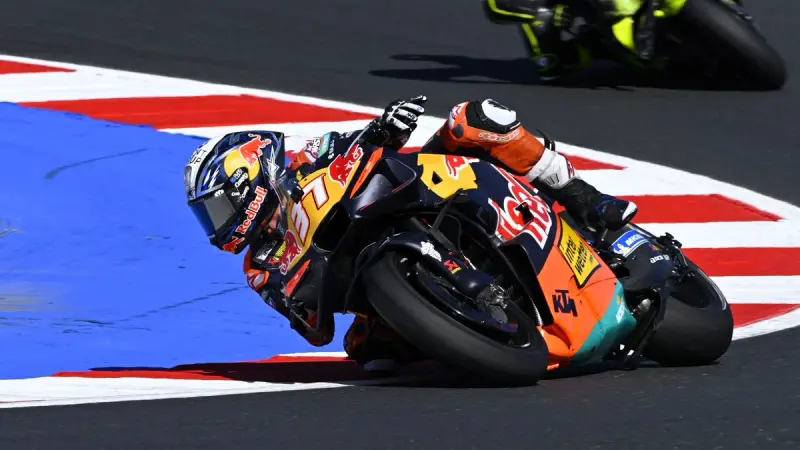
KTM’s 2026 MotoGP campaign began with a statement: Pedro Acosta won the season-opening Buriram Sprint and initially looked set to lead the championship. He stayed at the front of the standings until the fourth round in Brazil, but as the year progressed, Aprilia and Ducati moved ahead and became the dominant forces.
For KTM, the shift has been defined by two separate stories. On one hand, the team has faced engine reliability problems, which have hurt its overall momentum. On the other, KTM has still been able to remain firmly in the fight for third in the constructors’ standings—largely due to Acosta’s performances. While the Italian manufacturers have pulled away, KTM is described as comfortably ahead of Honda and Yamaha, with Acosta also standing out as the only KTM rider inside the championship’s top 11.
That context matters when KTM’s leadership tries to pinpoint what’s holding the RC16 back. Asked to identify the bike’s weakest area, KTM motorsport director Pit Beirer focused on a specific “crucial moment” at corner entry—rather than a broad, vague deficit.
Beirer explained that the problem shows up when the rider transitions from braking to turning. “Very simple, but it’s not so easy to fix it,” he said. “It’s definitely always just the point when we turn and release the brake.” In his view, riders can look where they want to go and get the bike moving in the right direction, but KTM’s RC16 struggles for a brief instant during that transition. “When the riders talk to me it’s, ‘Okay, the others look in the direction they want to go, and their bike is going, and we struggle for one moment still to turn’,” Beirer said. “That’s exactly the moment where we need to improve.”
The knock-on effect, according to Beirer, is not simply about turning itself, but about what happens immediately after. If the bike turns a little better, the rider can pick it up earlier, place the tyre correctly, and then drive sooner. “Then the rest is just a follow-up of that,” he said. “Because if you turn a little better, you pick up [the bike] more early, so you put the tyre in the right place and you have more drive.”
Beirer also described how KTM’s current situation can look like a power issue even when it isn’t. “We miss drive, but we are on the side [of the tyre still leaning] and so we are spinning,” he said. “So it’s not missing power, you’re in the wrong position to accelerate.” In other words, the bike’s position at the moment of acceleration is compromised by that earlier transition, leading to wheelspin rather than clean traction.
The most striking part of KTM’s analysis is how much Acosta has been able to compensate for that weakness. Beirer said Acosta makes the difference precisely where the RC16 is least effective. “Yeah, he helps the bike the most to open earlier and turn,” Beirer said. “He supports the bike a lot in that moment.” He added that Acosta’s braking strength is central to the workaround: “Because he’s so incredibly strong on the brakes and still makes his turning happen.”
Beirer even admitted that, from a data perspective, Acosta’s ability to execute that transition remains difficult to fully explain. “We wonder sometimes on the data, how he does it,” he said.
Acosta’s season has reflected that role. The Spaniard has delivered eight podiums in what is described as his final KTM season, keeping him fifth in the world championship and within reach of his target of finishing in the top three. Even with KTM’s broader struggles—especially reliability—Acosta’s ability to “support the bike” at corner entry has kept him as the key reason KTM remains ahead of the rest of the pack behind Aprilia and Ducati.