DUCATI CEO PRAISES MARC MARQUEZ’S ADJUSTMENT AFTER SAN MARINO WIN
5d ago·
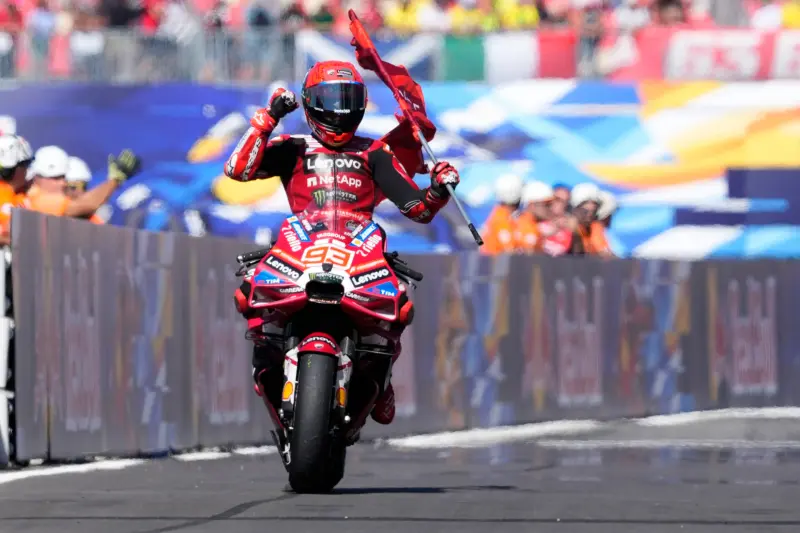
Ducati CEO Claudio Domenicali believes Marc Marquez’s way of working—especially when things aren’t going perfectly—has helped create the “huge desire” inside the team to keep pushing toward wins. Speaking after Marquez took victory at the 2026 San Marino Grand Prix at Misano, Domenicali framed the triumph as both a sporting result and a sign of how Marquez has adapted his approach over time.
Marquez, 33, won at Ducati’s home circuit and moved to the top of the 2026 riders’ standings for the first time. He is tied on 274 points with Aprilia’s Jorge Martin, but leads on countback thanks to five wins versus Martin’s single victory. The San Marino win added to a strong run in the previous seven rounds, with Marquez also winning in Hungary, Czechia, Germany and Aragon.
The race itself was not straightforward. Marquez took the lead at the end of Lap 1/27 after Aprilia rival Marco Bezzecchi crashed out at Turn 13. Martin briefly challenged and took over the front, but Marquez later began suffering from arm pump and eventually dropped to fifth. From there, he had to manage the situation and rebuild his pace, ultimately fighting back to take the win.
Domenicali highlighted the competitive pressure and the team’s ability to stay focused. Marquez’s Gresini teammate and brother Alex Marquez kept him honest throughout the closing stages, with the pair crossing the line just 0.657s apart. Marquez also admitted the victory required mental control: he said he “relaxed too much” after Bezzecchi’s crash, then had to regain composure. He described the key turning points as needing to overtake Martin into Turn 6 on Lap 12/27, before then fending off Alex in the final phase.
For Domenicali, what stands out is not only the result, but the attitude Marquez brings in the Ducati garage. He said: “Champions know how to evolve.” Domenicali added that Marquez is “an extraordinary athlete” and that he “teaches us a great deal,” pointing to how Marquez has changed “enormously” across his career.
Domenicali compared Marquez’s earlier Honda-era habits with his current reality. He said that back when Marquez raced for Honda, he used to “engineer crashes” in the sense that on Fridays and Saturdays he would “always and constantly test the limit.” Now, Domenicali argued, Marquez can’t afford that same approach because “his body no longer supports him as it once did.”
Even with that limitation, Domenicali said Marquez still has “incredible talent” and “unbelievable determination,” and that Ducati has also discovered “a fantastic ability to work as part of a team.” He explained that when Marquez doesn’t feel comfortable in a corner, he doesn’t just push harder—he identifies the root of the problem. As Domenicali put it, Marquez tells the team: “It’s me who isn’t doing it properly here, so there is no point in touching the bike.” Domenicali added that when Marquez says something isn’t working, the team understands there is “really” a bike issue, and that this mindset creates “an incredible spirit throughout the team,” along with “a huge desire to keep pushing.”
Domenicali also addressed the practical challenge Marquez faces in managing his physical condition. He urged Marquez to “push less” in practice as well, explaining that Marquez still has room to rein himself in to help protect his body. Domenicali linked that need to the surgeries Marquez has required on his right arm and shoulder in recent seasons, emphasizing that Marquez must conserve energy for the main races.
With Marquez’s win at Misano and his move to the top of the standings, Domenicali’s message was clear: the evolution in Marquez’s working methods—less limit-chasing in sessions, more precise communication and team-focused effort—has become a central part of Ducati’s momentum as the season continues.