KTM TRACES RC16 ENGINE FAILURES TO A QUALITY-CONTROL FAULT AFTER SEVEN BLOW-UPS
6d ago·
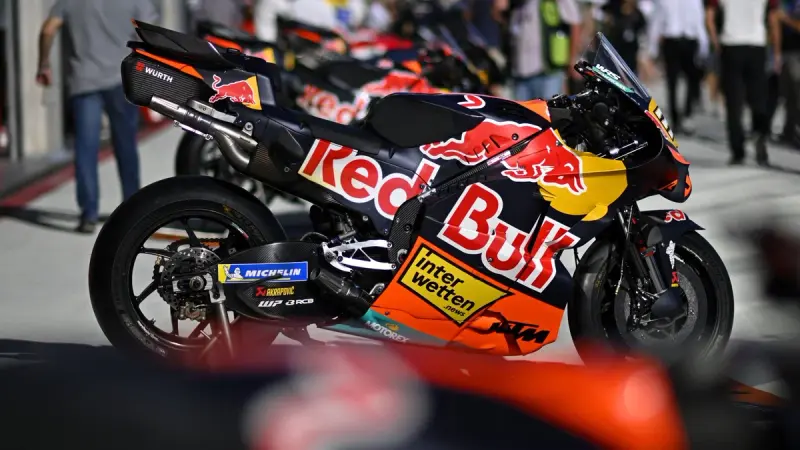
KTM has traced a run of MotoGP engine failures to a hidden quality-control fault inside a high-stress powertrain component supplied externally, a problem that Pit Beirer described as the “most horrible time” of the RC16 project.
The crisis unfolded during a season when KTM was trying to return to normal after its wider financial troubles. Beirer said the situation was especially difficult to grasp because the engine specification had been frozen following last year’s homologation. In his view, the expectation was that the “same” engines would behave the same way, yet multiple units began failing.
KTM eventually identified the root cause as a quality issue rather than a design change. The company could not immediately replace the affected parts, however, because MotoGP engines are sealed and can only be opened with permission from rival manufacturers—who, Beirer said, were naturally suspicious.
Explaining the emotional and operational impact, Beirer said: “This year, I thought we go back to a normality, then this engine issue almost killed us.” He added that the combination of a faulty internal part and sealed engines left KTM unable to respond quickly: “We lost completely control and could not react with having a [faulty] part in the engine, having sealed engines.”
He also described how the homologation rules removed the usual troubleshooting options: “After last year’s homologation, it was the same engine last year, this year. You’re not even allowed to touch one part.”
While KTM worked through the investigation, other reliability problems compounded the picture. One of the most visible incidents came when Pedro Acosta lost power while leading in Catalunya, triggering a major crash after he was hit from behind by Alex Marquez. Beirer clarified that this was caused by a separate ECU issue, not the internal engine fault. He said the ECU problem involved a sudden switch-off with no signal for a moment, after which the bike returned to normal.
Beirer explained that Magneti Marelli support helped KTM understand what was happening, but he stressed that the ECU incident did not directly break engines. Instead, the undiagnosed internal problem that KTM was still dealing with then led to multiple failures at the following round in Mugello.
KTM’s turning point came in Mugello, where Beirer said the team realised the engine issue was escalating. “We realised [we had the engine problem] in Mugello,” he said. “We broke an engine in the morning… But we broke two more engines on the same day.”
From there, KTM faced a difficult choice: which engines could be trusted. Beirer said the team began reverting to older units with higher mileage because they believed those engines could not have the same problem. He also described the failure pattern as sudden and short-range, occurring roughly “50-100 km,” which suggested something internal was breaking abruptly.
Because KTM could not request permission to open engines until it knew exactly what it was dealing with, the investigation became a documentation exercise. Beirer said the team had to identify the supplier, the specific problem, and provide evidence such as X-ray pictures. He added that IRTA was present in the building observing the process and that support from other manufacturers arrived in stages.
Beirer acknowledged why some rivals were hesitant at first: “The other manufacturers didn’t really agree immediately… because you’re suspicious.” He said that when one team asks to open engines, others naturally question what they are trying to do.
Once KTM could demonstrate the fault was caused by quality control rather than a design change—and that it posed a safety concern—permission was granted. Beirer said the other manufacturers could see the issue clearly: “There was air where there should be a connection and welding.” He thanked them for giving the green light between Sachsenring and Silverstone to change the faulty parts.
KTM also addressed the question of whether performance was reduced to manage risk. Beirer said the team reduced performance from Mugello, but not by simply lowering the rev limit on the affected engines. Instead, the team switched to older engines, which he said was “more effective” than reducing RPM alone. He also said the problem was “too big” to solve through RPM reduction.
In total, KTM reported seven engines that “blew up” within a certain period. Beirer said Acosta was “a bit luckier” than Brad Binder, with KTM losing only one engine with Pedro, but the overall tally still reached seven failures.
Beirer pointed to Aragon as a sign that KTM had regained momentum. He said he was “really happy” to see Acosta “picked it up in Aragon maybe where we left it in Barcelona,” noting that until Barcelona KTM had been closing in before the engine problems struck.
Even with the fault now understood and corrected, Beirer warned that KTM may have to run some remaining engines longer than planned, which could affect performance. He also said he hopes the team can return to a “normal scenario” from here.