MARC MARQUEZ SAYS INCONSISTENT FRONT BRAKE COST HIM IN AUSTRIAN GP
7h ago·
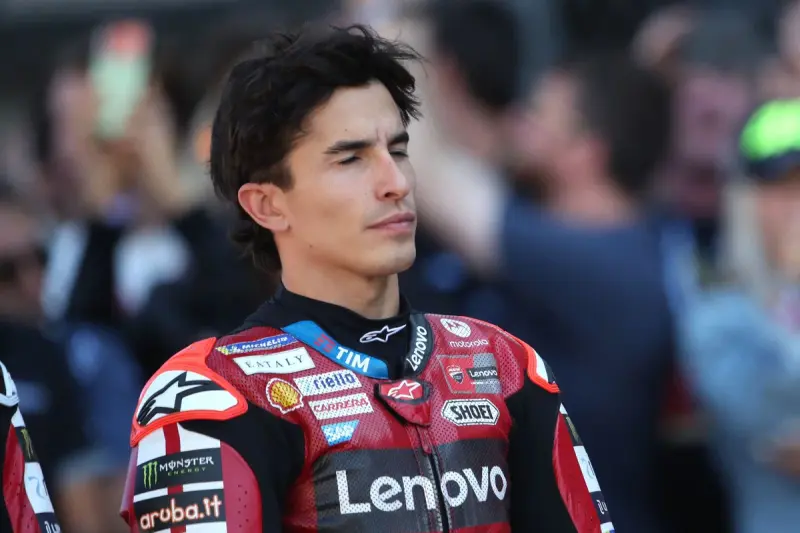
Marc Marquez admitted that the Austrian Grand Prix could have ended early for him after a front-brake problem severely disrupted his race at the Red Bull Ring. The factory Ducati rider had been expected to fight near the front over the 28 laps, especially after making several changes during warm-up that suggested an improvement in his pace. Instead, his Sunday unfolded with difficulties from the opening stages, and although he ultimately took the chequered flag in fifth, he was more than seven seconds off the lead.
Marquez described how the issue made his braking inconsistent lap after lap. He said he had the speed to challenge for second or at least be in the podium fight, telling the media: “It was not difficult, the P4, or at least fighting for the podium; I think the speed was there.” He added that while the weekend had been tougher than others, they were still in contention: “We were struggling more than in the other weekends, but we were there.”
However, the reigning champion’s problem was not simply a lack of pace—it was the way the front brake behaved. “But the problem is that in the first part of the race, I had many, many problems with the front brake,” Marquez explained. He said the inconsistency affected every braking attempt, which in turn forced him to adjust his riding and contributed to a costly moment at Turn 1 on lap 10, when he ran wide.
He pinpointed the root of that mistake, explaining that the braking power was effectively gone at the critical moment: “When I had the mistake at Turn 1, the brake was empty; there was nothing there.” Marquez said the lever felt unreliable, with braking points behaving differently each time. “The front lever was inconsistent; every brake point was in one way.” With that uncertainty, he had to go wide: “For that reason, I went super wide.”
The Ducati rider also revealed that the situation became serious enough that retirement crossed his mind. “I feel like today we were very lucky, because in one point of the race I thought, ‘OK, I cannot continue’.” According to his account, the problem was not constant throughout the race—braking began to improve after the early laps. “But then, brakes from one lap to the other started to work.”
As the front brake returned to a more usable state, Marquez said he was able to rebuild his pace and start gaining places again. “And then I started to be faster again, gaining some positions. But obviously it was too late.” Even so, he emphasised that the outcome could have been worse, and that the final result reflected both the damage done early and the recovery once the braking stabilised.
Marquez also explained how he managed the bike in the first phase of the race. “We had a big issue. For that reason, in the first laps, I was not hard on the brake points.” Rather than pushing at the limit, he focused on understanding what the lever was doing at each braking zone. “I was just trying to understand where the front lever was every brake point, and then I was losing a lot there.”
From a championship perspective, the fifth-place finish still carried consequences. The result left him 12 points behind Jorge Martin, with Marquez now having dropped points in the standings.
Despite the setback, Marquez framed the day as a learning opportunity as well as a stroke of luck. He said the team can identify the problem through data and work toward solutions for the future: “The positive thing is that it’s something you can see on data, so they can analyse and try to have some solutions for the future.”
Ultimately, he summed up the contrast between what he felt was possible and what the race allowed. “I feel very lucky because today, the maximum position was second, third, and in the end we finished fifth. So, let’s see.”