POL ESPARGARO SAYS MISANO Q2 LAP WAS MADE POSSIBLE BY ACOSTA AND MARQUEZ
11 Sept·
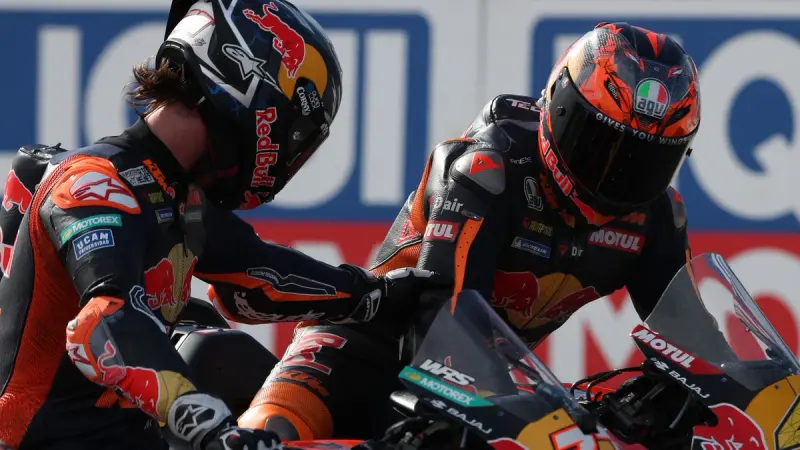
Pol Espargaro described his Misano MotoGP Q2 breakthrough as a “crazy” lap that came together thanks to a rare slice of timing and drafting behind two of the grid’s biggest names. The KTM test rider, filling in for the injured Maverick Viñales for his third race as a stand-in, had struggled to find momentum earlier in the 1000cc/Michelin re-adaptation period—qualifying 21st and 20th in his previous two outings.
At Misano, however, he was able to force his way into Q2 and is now guaranteed a start no lower than 12th after a strong Friday Practice run that placed him ninth, less than 0.2 seconds behind KTM’s leading rider Pedro Acosta. Espargaro said the key moment came when he was able to latch onto the pace in front, first with Acosta and then with Marc Marquez ahead of him.
“It was crazy!” Espargaro said of his Q2 performance. He explained that his first attempt in the session felt impossible to improve, telling his technician Manu that the bike felt “so, so fast, and dangerous,” and that he felt “like I was over the limit all the time.” But the lap changed when he returned to the track and found a rhythm behind Acosta.
“Then I went back on track with Pedro in front, and thanks to him I did what I did. And in front of Pedro was Marc…. I said, ‘Oh God, save me’, you know! And then I could make it.”
Espargaro also framed the experience as something special for a long-time fan and rider, adding: “It was an amazing feeling, an amazing experience. I've been racing for many, many years, but when these things happen, like being behind Marc and Pedro, the present and future of MotoGP, as a fan of MotoGP, it was an insane feeling. It was so, so nice.”
He noted that the benefit of following another rider is not automatic—it depends on who you are behind and how they ride. “Yeah [the turbulence] makes it harder, but it depends on which rider you are following.”
Beyond the immediate drafting effect, Espargaro gave a more technical explanation for why copying the right rider mattered. He said Acosta’s braking style is both late and smooth, with lines that are easy to emulate: “Pedro is a guy who brakes so late, but is so smooth and nice on his lines and always braking so much on the limit that you just need to copy, let’s say.”
He also referenced how he had previously learned to wait for the right moment in the field. “If you have someone in front that maybe is going to make a mistake - and it happened to me for example in Aragon.” He described how he had tried to follow multiple riders before finding a lap that clicked only once he was behind Fabio Quartararo, praising the Frenchman’s stability: “Because he was smooth, braking on the limit, opening the lines, being super nice with the bike on the throttle, not making crazy movements.”
“I knew that behind Pedro today, I could make it. And it's thanks to him,” Espargaro concluded.
The Q2 surge also reflected changes he has been making to his setup and riding approach. Espargaro said he has been focused on KTM’s 850cc/Pirelli prototype ahead of the Tech3 call-up, but that he had to rethink his usual way of riding as the category evolves. “The category keeps changing every year, and I figured out that riding how I normally ride the bike was not useful anymore,” he said.
He traced the shift back to Aragon, where he began altering his position on the bike. “From Aragon to here, I changed my tank spacers to put me a little bit more backwards on the bike.” He said it was the first time in his career he had made that specific change, and that it was driven by the need to improve stopping and traction: “we realised that riding with our bike more backwards helps on stopping, on traction.”
Espargaro added that this change reflects a broader requirement to adjust braking, line choice, and corner entry technique: “This shows that the way I've been always riding, putting so much pressure in front, is not useful anymore. You need to change your way of braking, opening the lines, and turning.”
He also pointed to aerodynamic differences on the KTM. “From last year to this year, we took out a lot of downforce on the bike,” he said, explaining that KTM reduced front and rear wing elements and removed rear swingarm “Dumbo ears.” He said the package reduced weight but also significantly lowered downforce, forcing a different riding style: “And when you reduce so much downforce, the way of riding needs to be changed as well.”
Because he had not been able to test the new approach extensively, he said he needed to copy someone fast—choosing Pedro as the reference point. “This is something that you realise by riding, and I have not ridden, so I needed to copy someone, and I choose Pedro, who is the fastest [KTM]. It worked out, so let's see if tomorrow I can keep going.”
In Friday practice, KTM’s other riders were Enea Bastianini in 11th and Brad Binder in 15th.