UCCIO SALUCCI SAYS CASEY STONER WASN’T HAPPY WITH VALENTINO ROSSI’S 2008 SEASON
9 Sept·
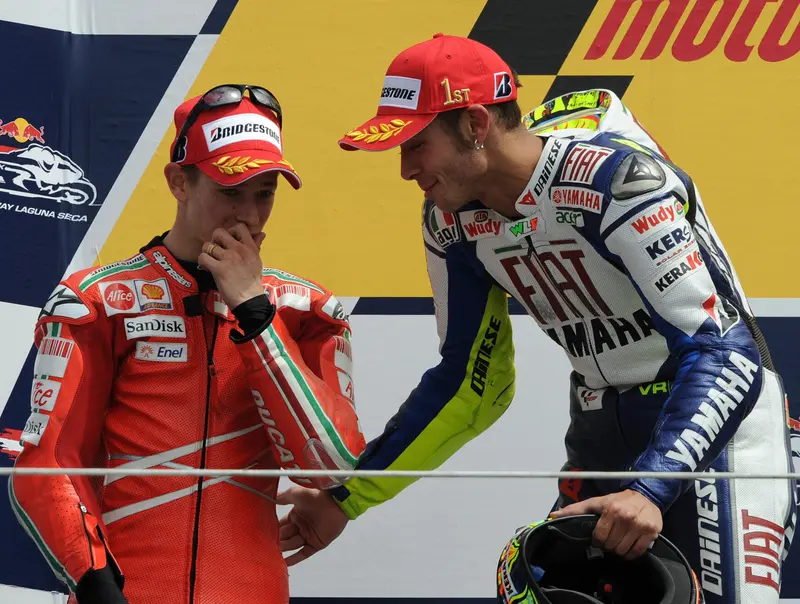
Uccio Salucci has picked out 2008 as the Valentino Rossi season he’d most want to relive—an era that, in his telling, sharpened the rivalry with Casey Stoner into something uniquely intense.
Salucci, who worked alongside Rossi throughout the Italian’s most storied MotoGP years, described the relationship between the pair as one of the fiercest in the sport’s history. He pointed to how different they were in approach and how rarely they seemed to agree, especially once both riders began fighting for championships. Stoner’s breakthrough came in 2007 when Ducati reached the top of MotoGP for the first time, while Rossi finished third in the standings. That contrast helped ignite the rivalry, and it escalated again in 2008 as both men returned to battle for the title.
Salucci’s focus on 2008 wasn’t just about the end result, but also about the obstacles Rossi had to overcome early on. He said the season was difficult “especially at the beginning when the Bridgestones weren’t working properly.” In his account, the turning point arrived when Jeremy Burgees lengthened the swingarm in China, after which Rossi won the race. From there, Salucci said the team tightened together, adding that Rossi was coming off the back of a nasty tax row from the previous year and that the pressure to deliver made the collective effort even more important.
A key part of Salucci’s memory is the way Stoner reacted to Rossi’s resurgence. He recalled that there was “a superb Stoner, who wasn’t very happy with it,” and concluded: “so it wasn’t easy.” The quote ties directly to the broader theme of a rivalry where Stoner’s respect for Rossi appeared to be tested at Laguna Seca in 2008, after Rossi’s famous Corkscrew move over the Australian during a back-and-forth battle.
The season also carried extra tension away from the front. Salucci noted that Rossi’s fans booed Stoner when the Australian beat the Italian at the British Grand Prix at Donington Park. That victory was one of six times in 18 races that Rossi and Stoner finished first and second in 2008, underscoring how often their paths led to the same decisive moments.
Rossi’s campaign began with him initially struggling to find consistent pace. Stoner won the season opener in Qatar, finishing ahead of Jorge Lorenzo on his MotoGP debut with Yamaha, with Dani Pedrosa third. Rossi’s early position was less dominant, and the pattern shifted as the season progressed: Rossi improved to second behind Pedrosa and ahead of Lorenzo, while Stoner dropped to 11th at Jerez. Rossi then took third at Estoril, with Stoner only managing sixth.
Shanghai marked Rossi’s breakthrough win. Salucci’s retelling highlighted that Rossi edged Pedrosa by 3.890 seconds, while Stoner finished third but far behind the lead, 15.928 seconds off the pace. After that, Rossi added victories at Le Mans and Mugello, though Pedrosa interrupted his momentum by beating him in Barcelona.
The middle of the season brought a downturn for Rossi. Salucci pointed to a slump across rounds seven to 10, during which Stoner responded with wins in Britain, the Netherlands and Germany, cutting Rossi’s advantage to within 20 points and narrowing the gap to Pedrosa to four. Yet Rossi responded strongly in the second half. Salucci’s summary of the turnaround emphasized that Rossi then “turned the screw” on both Stoner and Pedrosa, starting with the United States win and followed by a run of victories at Brno, Misano, Indianapolis and Motegi.
Even when Stoner won in Australia and Valencia—on either side of Rossi’s final win of the season in Malaysia—Rossi’s lead proved too large to overturn. The title was effectively secured in Japan with three rounds remaining, as Rossi’s victory at Motegi put him 92 points clear of Stoner. Ultimately, Rossi won the championship by 93 points, capturing his sixth premier-class title in what would become his seventh overall.