BAGNAIA SAYS DUCATI TEAMMATES LOOKED CLOSER AFTER AUSTRIA RESULT
1d ago·
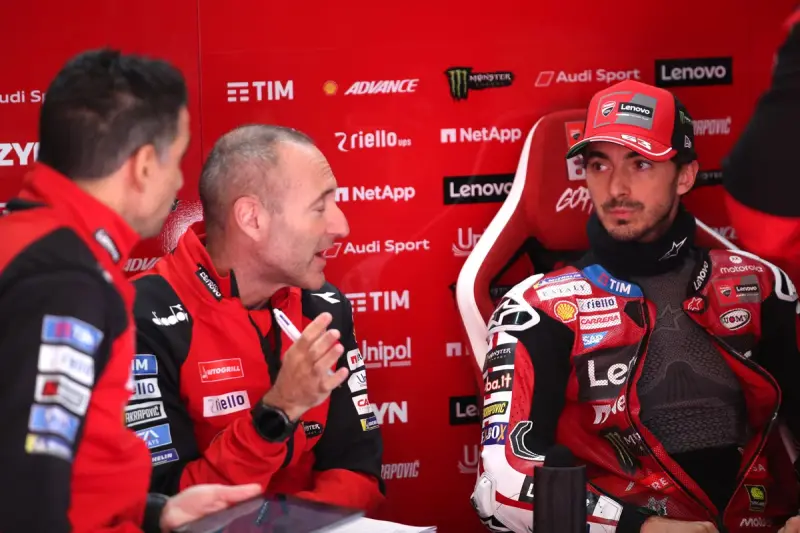
Francesco “Pecco” Bagnaia left the Austrian Grand Prix with a muted assessment of his weekend, insisting that while Ducati’s teamwork was strong, the gap to his fellow Desmosedici riders hadn’t truly closed in the way the results might suggest.
Bagnaia qualified seventh at the Red Bull Ring and finished the race in the same position, though he was later promoted to eighth after Fermin Aldeguer (Gresini) received a post-race penalty. Even with that adjustment, Bagnaia’s overall conclusion was that his outcome was “no better than usual,” and he questioned whether he had actually moved closer to the other Ducati riders.
Asked by Sky Italy to evaluate the weekend, Bagnaia said, “It’s hard to say.” He credited the team for working well together and doing “the best we could,” but added that the relative picture may have shifted the other way. “More than me getting closer to the other Ducatis, they got closer to me, honestly,” he explained. “Because in the end I was seventh, eighth; even in the other races I was close to doing that.”
Bagnaia also pointed to the nature of the circuit as a factor in why his results can look comparatively better there. “This is a track where you can get off the ground a lot, so it’s generally where I lose a little less,” he said. However, he still felt the performance gap was not where it needed to be, and he identified specific areas where Ducati appeared to be losing ground compared with previous years.
According to Bagnaia, Ducati’s issue was visible in both speed and traction phases. He said the team “noticed a loss compared to previous years,” describing shortcomings in “entry speed, corner speed, and especially in the first phase of pick-up,” where traction was not coming as effectively as desired. He linked the slower race tempo to the broader conditions, noting that the race was “quite slower than in the past” for everyone. Even the winner, Pedro Acosta, “wasn’t very fast in terms of race distance,” Bagnaia suggested, attributing part of the difference to conditions and the way Ducati had “lost a little more than we would have expected.”
Despite the lack of podium contention, Bagnaia did acknowledge that his pace was competitive in parts of the race. He said he beat VR46’s Fabio Di Giannantonio “on pure pace” and was only “a few seconds behind” fifth-placed Marc Marquez.
Looking beyond the immediate weekend, Bagnaia referenced data from earlier seasons to explain why Ducati riders can struggle at the Red Bull Ring. “These days I’ve also tried to look at the old data,” he said, adding that it clearly showed differences in “the final phase of corner entry and the first phase of corner exit.” In those phases, he claimed, Ducati riders had previously been able to carry more speed into the corners and improve traction.
He also contextualised the competitive landscape by pointing to other manufacturers’ progress. “I wouldn’t have expected Ducati to struggle so much,” Bagnaia said, “but I would have expected KTM and Aprilia to be so strong.” He noted that Aprilia had already looked strong the previous year, while KTM had made a significant step forward after engine changes introduced since Aragon, praising Acosta’s form: “Pedro is riding them very well.”
Bagnaia’s race also included a technical moment that echoed a similar problem he’d experienced with Marc Marquez earlier in the season. He said he had a comparable front brake issue during the Austrian race, explaining that the lever came close to his hand multiple times. “Yes... it [the lever] came very close to me, three times it reached my hand and I had to push it away.”
Overall, Bagnaia’s message was that Austria exposed weaknesses Ducati needs to address—particularly traction during pick-up and the early phases of corner exit—while also suggesting that the relative positions among Ducati riders were influenced by factors beyond his own progress.