APRILIA TECH CHIEF STERLACCCHINI SAYS APRILIA IS NOT USING AI IN MOTO GP DEVELOPMENT
31 Aug·
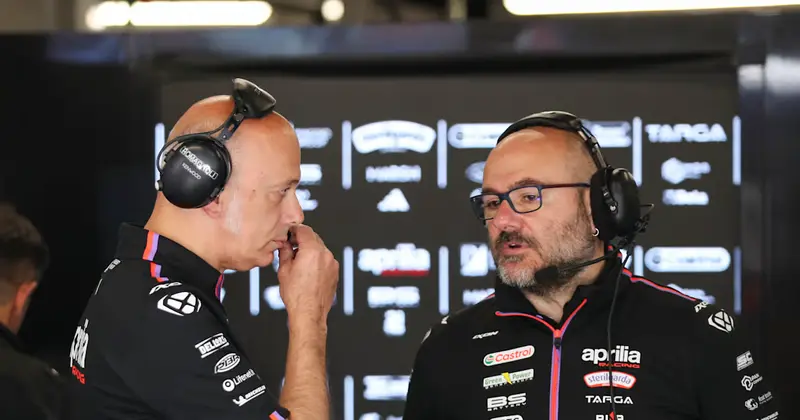
With MotoGP’s planned move from 1000cc to 850cc in 2027, Aprilia’s technical leadership is already thinking beyond the headline change in engine size. Fabiano Sterlacchini, Aprilia’s Technikchef, used a discussion on the “Mig Babol” podcast with former GP rider Andrea Migno to explain how the sport’s priorities will shift when roughly 50 horsepower disappears.
Sterlacchini estimated that dropping from 1000 to 850cc would mean “around 50 PS” less peak power. In his view, that isn’t simply a loss to be compensated with more engine work—it changes where the time is actually spent on track. He pointed out that today’s MotoGP machines operate at full motor potential only for a limited fraction of a lap: “in one lap about 15 to 20 percent of the time” the bike is truly at the engine limit, with the throttle “completely open.” If the power drops by 50 PS, he expects that the portion of the lap where the engine’s top end matters will grow: “30 to 40 percent.”
That, he argued, makes pure engine performance more important than it has been. “How important is it today to find one horsepower at the engine?” he asked rhetorically, answering that it matters less because riders don’t use the full power for long. “From next season it will be twice as important,” he said, framing the regulation change as a reason to reweight development effort.
Sterlacchini also described how he approaches technical direction within Aprilia, saying his role is “90 to 95 percent” technical and only a small part sporting. To illustrate the challenge, he compared the job to conducting an orchestra. “You can have very good musicians, but the one playing the drums might be too loud and cover the brass,” he said, adding that different players may be suited to different styles. But, he continued, a conductor must do more than keep everyone together: “At some point he has to say: we’re missing a piano, I want an oboe.” The point is investment decisions—“We have to invest in this instead of that.”
Looking at where MotoGP still has room to improve, Sterlacchini believes aerodynamics remains a major opportunity. He said that aerodynamics currently dominates because the engine concept has been refined for so long that there is less left to unlock there. “In aerodynamics, compared to Formula 1, in my opinion we are between 30 and 50 years behind on motorcycles,” he said. “There’s still a lot to discover.”
He also highlighted a specific aerodynamic effect that can be created by rider movement. If a rider leaves the fairing or extends a leg, Sterlacchini explained, they generate a force “offset” from the bike’s centerline. During braking, he said, that resistance can help the motorcycle turn in and be steered into the corner “like a rudder, only with air instead of water.” He added that “until about ten years ago, nobody thought about it.”
On the subject of copying ideas from rivals, Sterlacchini said Aprilia is aware that competitors are taking inspiration from other teams. However, he warned against imitation as a strategy. “You must never be the one who just imitates and copies, because then you always arrive too late,” he said. He also cautioned against the opposite attitude: “And you must never be too proud that you don’t copy.” Even if a component works on one bike, he argued it may be ineffective elsewhere because it may not work in harmony with the rest of the package: a rear-mounted part “could be completely useless” if it doesn’t operate “in symbiosis with the rest.”
Finally, Sterlacchini addressed the hype around artificial intelligence in motorsport. He said he doesn’t see AI as a magic solution and that Aprilia does not use it in the way many others claim. He also gave a reason why aerodynamics is harder on motorcycles than in cars: in Formula 1, he said, a single detail under the floor can quickly add “40 kilos” of downforce, and he believes there is no comparable single part on a MotoGP bike—“maybe not even the entire aerodynamics.”
AI, he said, could help make relationships visible that can’t be translated into equations using today’s knowledge and all physical parameters. But he rejected the broader trend: “We don’t use it at all. Everyone uses it, everyone talks about it, they use it for everything. You’d have to give it a dimension.” He even issued a warning about unintended consequences: “If we get a problem with the uselessness of humans, then maybe we created it ourselves.”