ENEA BASTIANINI SAYS HE HAS LOST HIS EDGE ON ENTRY AFTER WATCHING PEDRO ACOSTA IN ARAGON
1 Sept·
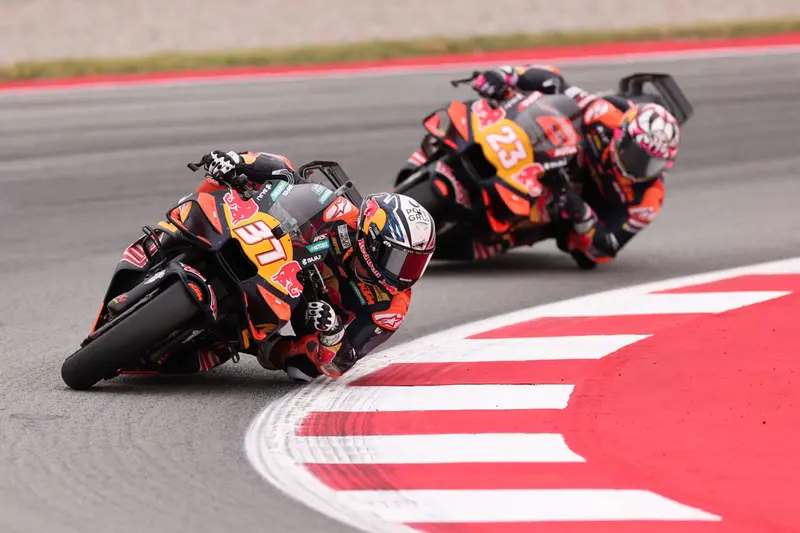
Enea Bastianini said watching Pedro Acosta’s Aragon Grand Prix performance brought back memories of what he believes used to be one of his strongest traits—only for him to admit that he hasn’t been able to reproduce it in recent seasons.
At Aragon, Marc Marquez ultimately won the race, but Acosta delivered a tense, high-level fight with the reigning world champion and still managed to secure a crucial podium. Bastianini pointed to the way Acosta put everything together, even while acknowledging that the KTM is not on the same level of machinery as Marquez’s Ducati GP26.
Speaking to GPOne and other outlets after the event, Bastianini said Acosta’s start was the key difference. “He drove exceptionally well. I looked at the data, and he was riding really well. Above all, he managed to put all the pieces together. You could really tell he was riding with confidence,” he said. In Bastianini’s view, the confidence showed immediately. “When someone rides well and has confidence, you notice it right away. That, in my opinion, was the difference. Doing what he did today is tough. It’s not easy.”
Bastianini then focused on the specific area where he believes Acosta made the biggest impact: the entry phase into corners. “In entry—that’s where he makes the difference, and it’s something I haven’t been able to do well for quite some time. I’ve lost a bit of my edge on entry, which used to be one of my best qualities,” he said. He added that, since arriving at his current team, regaining that particular skill has been the one thing he has not managed yet. “Since I arrived here, that’s the one thing I still haven’t been able to regain. But we’re working on it; we’re doing everything we can to get it back.”
Bastianini also described how Acosta’s confidence-driven approach shows up in braking and corner management. He said Acosta relies less on holding the brakes as late as possible and more on being able to release them and let the bike work through the turn. “Confidence in the front end definitely plays a role. But there’s also the matter of being able to release the brake. That’s something I’m not doing well right now,” Bastianini explained.
To illustrate the contrast, he compared his own braking habits with Acosta’s. “Compared to Pedro, I really notice that, in the final part of entry, I keep the brake on until the very end, then I go straight onto the throttle. He, on the other hand, has that phase where he manages to release the brake and let the bike go. He’s very good at that.”
The discussion naturally drew attention to Marc Marquez, whose late-braking style is widely associated with his riding identity. Bastianini’s comments also underlined why Acosta’s approach stands out: even though Marquez is the benchmark for braking artistry, Acosta’s method is not built around the same last-moment brake pressure. The sources also noted that Acosta does not use signature Marquez tactics during races, and Bastianini’s observations about brake release and confidence align with that idea.
With Marquez and Acosta both set to be on Ducati machinery from next year, the Aragon result was framed as a warning shot about future battles on equal equipment. Acosta’s ability to extract a podium from a KTM that is not as strong as the Ducati GP26 was part of what impressed Bastianini most.
Looking ahead, Bastianini’s comments leave an intriguing question hanging over Ducati’s future direction: when Acosta and Marquez become teammates, will the 2027 bike favor the late-braking style associated with Marquez, or the more cautious, brake-release-focused approach Bastianini says Acosta excels at?