JACK MILLER PRAISES YAMAHA M1 HANDLING AFTER ARAGON RACE
30 Aug·
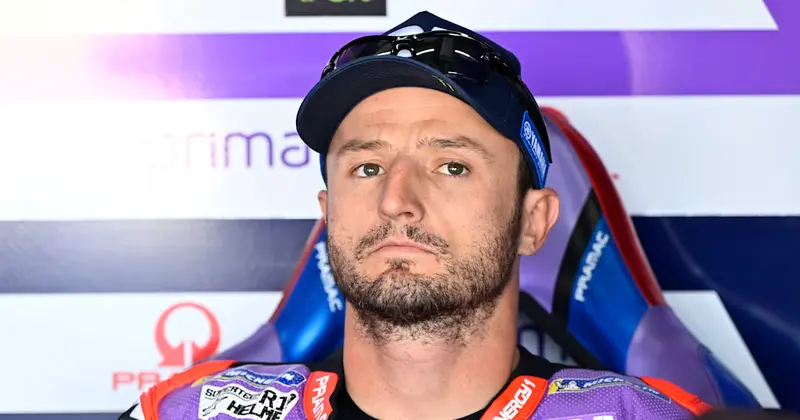
Jack Miller’s Aragon Grand Prix delivered a rare, upbeat assessment of Yamaha—despite a result that, on paper, offered little to celebrate. The Pramac rider finished the race as the leading Yamaha on 11th, 27.2 seconds behind winner Marc Marquez, and in the closing stages he was overtaken by KTM riders Enea Bastianini and Brad Binder. Miller admitted the fight slipped away, but he framed the weekend as a step forward for the M1, particularly in how it behaves in corners.
“Everything in all, it was a good weekend. I gave everything I had in this race,” Miller said. “Unfortunately, in the end we had to give up positions to the KTM. I tried to make it as difficult as possible for them, but somehow I was fighting with my hands tied behind my back.”
The Australian pointed to the familiar limitation: Yamaha’s lack of top-end speed. He explained that while he could pressure rivals under braking, he struggled once the race moved onto the straights. “We lose too much on the straight,” he said, adding that the team already knows the problem. “We can’t really do much about it at the moment, so it doesn’t help to complain. We just have to keep working with what we have.”
In the battle with Bastianini, Miller described how he attempted to disrupt the KTM’s rhythm. “When Enea came by, I tried to make it as hard as possible for him by braking very late. But in the end he overtook me in the middle of the straight and then held a very tight line in the last corner. Brad did exactly the same. There’s not much more you can do.”
Even with that handicap, Miller’s overall verdict on the bike was notably more positive than the criticism Yamaha has faced in recent weeks. “Honestly, the bike works quite well,” he said. “In the corners I can’t really complain. We just lose too much on the straights, but we know that.”
Miller also said he was satisfied with his own execution. “I was really happy with my pace and I made no mistakes. In the first lap I had a small touch, but apart from that it was a pretty clean race until the end.”
A key factor, according to Miller, was how he managed the front tyre. After learning from Saturday’s sprint, he approached the Grand Prix more carefully with the front. “If you preserve the front tyre, you lose a bit of corner speed,” he noted. “Yesterday in the sprint I was one of the fastest in that area. I think in the last sector overall I was about fourth and even faster than Marc—and I can assure you it wasn’t from the back straight.”
However, he said he couldn’t keep that aggressive, high-demand style for the full race distance. “In the main race I couldn’t ride the bike like that. Then you get too much front-end understeer and you destroy the tyre, so this time I was more cautious.” The strategy paid off: both tyres lasted into the final stages. “In the last lap it got pretty critical, but until then I was really happy with the performance. The tyre was worn out at the end, but that’s exactly how it should be.”
Beyond the immediate race, Miller highlighted what he sees as meaningful progress in Yamaha’s development. He contrasted the current M1 with the difficulties at the start of the season, when the completely new machine struggled more. “Of course, it changes the character of the bike when you add 20 more horsepower,” he said, referring to the ongoing power deficit. “But I still believe we’ve improved this bike a lot in a pretty short time.”
Miller stressed the project’s youth and the team’s focus on extracting the maximum from the current package. “It’s a completely new motorcycle this year. We’re trying to get the maximum out of what we have.”
His conclusion after Aragon was that the chassis—and especially cornering behaviour—has moved to a more competitive level, even if the engine remains the decisive weakness. As long as the M1 continues to lack clear straight-line performance, Miller suggested, even the best Yamaha rider can only exploit the bike’s strengths in direct duels to a limited extent.