MARC MARQUEZ’S ARAGON WIN HIGHLIGHTS RIGHT-ARM LIMITS, SAYS OXLEY
4d ago·
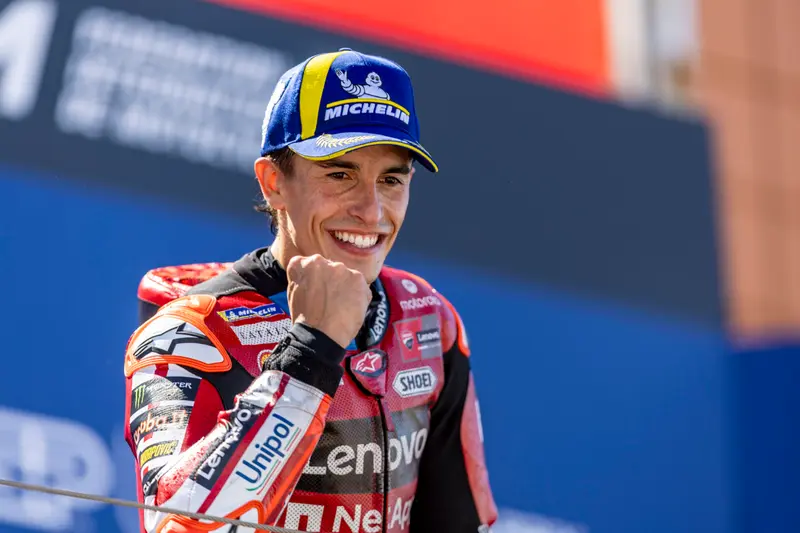
Marc Marquez extended his Aragon dominance with a record ninth Aragon Grand Prix win, a result that also lifted him back to second in the 2026 MotoGP standings. The Cervera rider’s latest triumph came after a season-long battle at the front: Aprilia’s Jorge Martin still leads the championship after 13 rounds with 256 points, but Marquez cut his deficit from 40 to 19.
Aragon has long been Marquez’s strongest hunting ground. Since MotorLand Aragon joined the calendar in 2010, no one has been anywhere near as successful across all classes. Marquez’s first win at the venue arrived in 2011 in Moto2, and he has since added eight premier-class victories in the semi-desert. He also won four consecutive MotoGP races there from 2016 to 2019, while no other rider has managed more than two wins at Aragon across all categories.
The 2026 Aragon GP, however, didn’t just underline his ability to win—it raised questions about how much he can push in the remaining rounds. KTM’s Pedro Acosta closed right up to him at the finish, coming within 1.754 seconds, and Aprilia’s Marco Bezzecchi had already denied Marquez pole with a new lap record in qualifying. Yet commentator Mat Oxley focused on something more fundamental than the margin to Acosta: the way Marquez had to ride through the circuit’s right-hand corners.
Oxley said it was “obvious” that Marquez’s “powers are depleted” because of the condition of his “much-mangled right arm and shoulder.” He explained that while Marquez could still attack Aragon’s 10 left-handers with his usual speed, he lacked the strength to save slides using his right elbow in the same way he used to. That forced a more conservative approach in the track’s seven right-handers, even at a venue where he is typically at his most comfortable.
The injury context behind that limitation is extensive. Over the last six years, Marquez has undergone seven surgeries on his right arm and shoulder, starting with the career-threatening injury he suffered at the 2020 Spanish Grand Prix at Jerez. The most recent operation came in May, when he had two screws and a bone fragment removed to address a radial nerve issue that had been present since the start of 2026. Oxley’s report also traced how the nerve problem was missed after earlier surgery: Marquez had surgery on his right collarbone last October following a coracoid fracture in Indonesia, but it wasn’t until he returned to the bike this season that he realised something was wrong. He later learned that two screws from the Latarjet procedure in 2019 had bent during his crash on the first lap at Mandalika last year.
Even after the May procedure, Marquez’s right arm continued to cause problems during the season. Oxley pointed to Silverstone, where Marquez had “no control” over his right arm, and Marquez himself admitted at Aragon that he attacked the British GP too “aggressively” from the off. At Aragon, despite delivering the win everyone expected, Oxley suggested the pattern of limitations could become more pronounced as the calendar turns.
Oxley linked the right-arm constraint to the structure of the 2026 schedule. He noted that the championship is the last of the 1,000cc era and that there are six anti-clockwise circuits among the 22 venues. With only two anti-clockwise races remaining—Phillip Island and Valencia—he argued that Marquez’s next stretch could be tougher than many fans might assume, even though he had won four of the last six Grands Prix.
In his view, Marquez will already be assessing where he can attack, where he must defend, and where he may only be able to “survive” rather than fight for maximum speed. With Aragon’s right-hand corner limitations clearly visible in the way he rode, the key question for the remainder of 2026 is how effectively Marquez can manage those constraints when the circuit demands shift away from his best track and toward the final anti-clockwise rounds.