MARC MARQUEZ’S ARAGON WIN LINKED TO DUCATI AERO CHOICE AND “ONE-AND-A-HALF ARMS” SETUP
30 Aug·
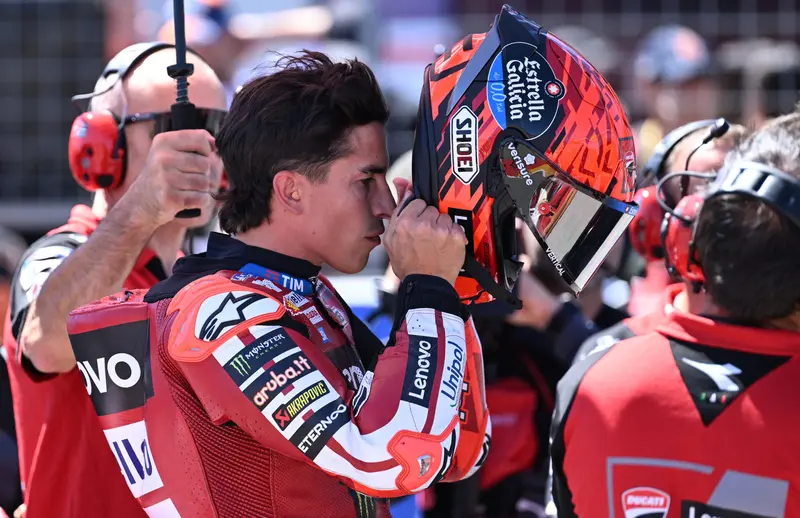
Marc Marquez’s Aragon Grand Prix win added another chapter to his season story: a dominant Sunday performance delivered despite ongoing concerns about his fitness. The result was his ninth victory across all Grand Prix classes, and it came after a weekend in which he had to manage both the race itself and the scrutiny around how he was coping physically.
On Sunday at MotorLand Aragon, Marquez was locked in a close contest for the lead, with Pedro Acosta challenging him during the race. Ultimately, the reigning world champion’s Ducati prototype proved decisive, and Marquez took the chequered flag first. The win brought his weekend points total to a perfect 37.
While Marquez’s pace stood out, the build-up suggested he wasn’t operating at the level some expected. The reporting around the weekend pointed to fitness struggles, and it also highlighted that he didn’t replicate the same kind of move he had executed in the Sprint race at Turn 1 against Marco Bezzecchi. Instead, the key moment in the Grand Prix came with a hair-raising pass on the back straight for the lead, setting up the duel that followed.
Neil Hodgson and Sylvain Guintoli were able to examine Marquez’s bike closely ahead of the race, and their observations helped explain how he was compensating. Guintoli noted that Marquez’s Ducati carried an aero package similar to the one the team used earlier in the year, whereas other Ducati riders had adopted the later upgrade. “If you look at Marc Marquez’s bike, you see that he’s got the aero package that all the Ducatis were running at the start of the year,” Guintoli said. He contrasted that with Pecco Bagnaia’s machine, pointing out that Bagnaia’s bike had the newer wing and that the airflow “comes in straight away” rather than being split. Guintoli also said Fabio Di Giannantonio and Alex Marquez were using the updated setup, but Marquez remained with the earlier configuration.
Guintoli explained why that choice might matter for Marquez’s riding style and physical limitations: “Marc Marquez stayed with the first one. He thinks that makes the bike a bit more heavy. And he likes the fact that the bike is a little bit more nimble.” Hodgson then added the broader performance trade-off. “What’s really interesting, essentially Marc Marquez is giving up a bit of efficiency because they know that this, with all the tests they’ve tried, works better as a package but it’s more physical and makes it feel a bit heavier,” he said. He went on to connect the setup directly to the demands of riding when strength is not at its best: “It’s a bit heavier in the changes of direction, especially at higher speeds, so he’s giving up a bit of performance because he’s racing with one-and-a-half arms.”
The “one-and-a-half arms” framing was also tied to the media narrative around Marquez’s condition. During Thursday media duties ahead of the weekend, he faced questions about his fitness and reacted sharply to the way the topic was being raised. He told Spanish journalists that Ducati had “caught him out” by referencing a private admission about his arm in the team’s post-race YouTube vlogs, which then reopened the discussion.
Taken together, the reporting paints a picture of a rider who is still finding ways to extract results through careful machine choices and adaptation. With the aero and handling characteristics tuned to suit his inputs, Marquez was able to convert that package into a decisive Aragon win, even as the fitness conversation continued in the background.