NICOLO BUGLEGA SAYS DUCATI’S 850 PROTOTYPE IS ALREADY CLOSE TO 1000CC LAP TIMES
2d ago·
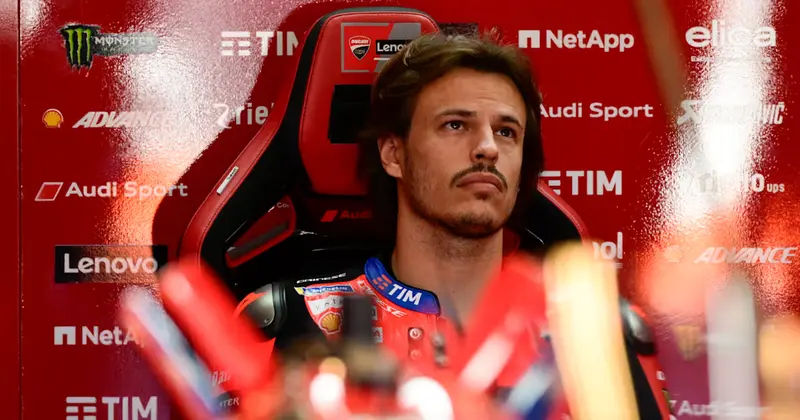
As MotoGP prepares to enter a new era in 2027, Ducati’s development work on the 850cc Desmosedici is already well underway. The shift is twofold: engine capacity drops from 1000cc to 850cc, and Pirelli replaces Michelin as the single tyre supplier. Among the key figures shaping the project is Nicolo Bulega, Ducati’s Superbike World Championship leader and a MotoGP test rider for the Italian manufacturer.
Bulega has spent several days on the 850cc prototype and, despite the programme still being in an early stage, he says he is encouraged by what he has found so far. Speaking during the Superbike weekend in Magny-Cours, the Italian explained that the project has only been running for a few months, which is why he believes there is “significant potential” still to unlock—both in the machine and in his own adaptation. “The project has only been running for a few months,” Bulega said. “So there is still significant potential. I rode the bike for a few days, but I think that next time I’ll be faster because I’ll have more experience with this bike.”
A major part of Ducati’s current focus is understanding the new Pirelli tyres, whose behaviour differs markedly from the Michelin rubber used on today’s 1000cc MotoGP bikes. Bulega stressed that the tyre change is not a minor detail, but something that forces the entire development direction to be reconsidered. “Ducati can understand better and better how the bike needs to be improved with the Pirelli tyres, because they are very different from the Michelin,” he said. “The whole package has to improve—the bike and me together.”
On performance, Bulega believes the gap to the current 1000cc machines is smaller than many might expect, particularly when considering straight-line speed and acceleration. He pointed to lap times as the most surprising indicator. “I think the base is very good,” he said. “With the new tyre, the lap times are already not so far away, considering that the bike is significantly slower on the straight and in acceleration.” While he avoided making a precise prediction for when the 850cc bike will match the pace of the 1000cc era, he also played down the idea of a dramatic step. “I can’t say when the bike will be as fast as the 1000s,” Bulega said. “But the step isn’t so dramatic.”
In terms of the bike’s “DNA,” Bulega does not expect a revolution in layout or feel. He described the chassis and aerodynamics as broadly similar to the current concept, with the overall size tending to be reduced because the engine is smaller. “Chassis, bike and aero are more or less very similar,” he said. “Tendentially everything is a bit smaller, because the engine is smaller.” For regular Ducati riders, he expects the transition to be manageable, especially regarding ergonomics and seating. “How you sit on the bike is very similar to the current 1000cc MotoGP Ducati,” Bulega said. “I think the riding position is the same.”
The biggest adaptation, in his view, comes from the tyres rather than the fundamental riding position. Some MotoGP regulars have already sampled the 850cc prototypes during Pirelli testing after the Brno race weekend, and Bulega said Ducati has not made major changes to the prototype since then. When asked whether the bike had changed significantly, he replied: “No, it was more or less very similar.”
With time still available before the 2027 season begins, Bulega expects the riders to have enough testing opportunities to get up to speed with the new package. He noted that MotoGP riders will have multiple test days before the start of the championship, with sessions planned after the initial test in Spielberg, followed by further opportunities in Valencia, Sepang and Buriram. “They will have four, five or six test days before the season starts next year,” Bulega said. “That will be enough.”
Even so, Bulega is clear that the 850cc bike is slower in absolute terms, and the difference can be felt. He referenced top speeds as one measurable indicator: while current MotoGP bikes can reach around 350 km/h on fast tracks, the 850cc prototype is currently below that figure. “Yes, it’s slower,” he confirmed. “But 335 km/h is still not bad. It’s a bit less than now, but it’s not Moto3 bikes.”
Overall, Bulega’s message is that Ducati’s 850cc transition is progressing with a solid foundation, lap times already showing promise on the new Pirelli tyres, and a development path that—while still early—should be supported by enough testing time for riders to adapt before the 2027 campaign begins.